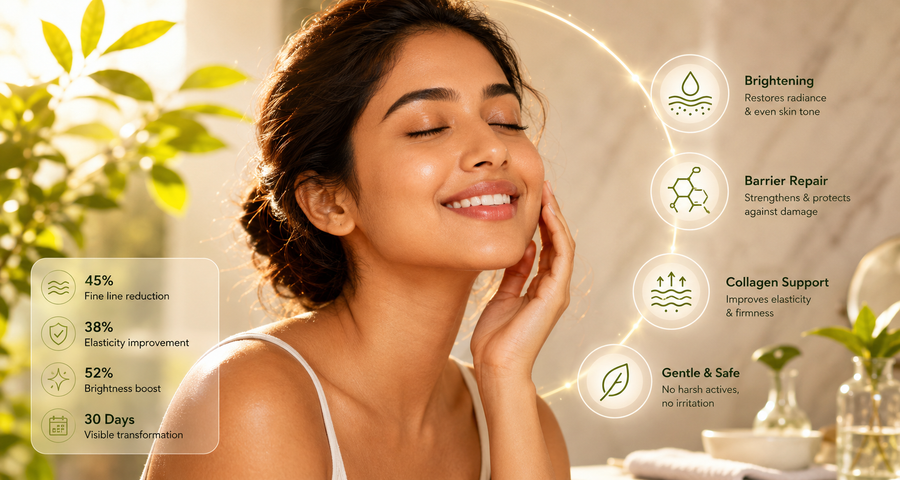
Skin Barrier Repair: Why Healthy Skin Starts with a Strong Barrier
Many people spend months searching for products that promise glowing skin, fewer breakouts, or a brighter complexion. They switch cleansers, buy expensive serums, and follow trending skincare routines, yet their skin never seems to improve for long.
The problem often isn't a lack of skincare products.
It's a damaged skin barrier.
Think of your skin barrier as the protective wall surrounding your home. When the wall is strong, it keeps unwanted things out while protecting everything inside. But if cracks begin to appear, dust, pollution, bacteria, and irritants can easily enter, while precious moisture escapes.
The result?
Your skin may suddenly become dry, sensitive, irritated, tight, or prone to frequent breakouts—even if it never behaved that way before.
The good news is that your skin barrier has an incredible ability to recover when it's given the right support. You don't need a complicated routine or dozens of products. In many cases, simplifying your skincare routine is exactly what helps your skin heal.
In this guide, you'll learn what the skin barrier actually is, why it's so important, the everyday habits that weaken it, and the best ways to help your skin become healthier, stronger, and more comfortable over time.
What Is the Skin Barrier?
Your skin is made up of several layers, each with a specific purpose. The outermost layer, known as the stratum corneum, acts as your skin's first line of defense against the outside world.
This layer is commonly referred to as the skin barrier.
Imagine a brick wall.
The skin cells are the bricks, while natural fats called lipids act as the cement holding those bricks together. When both the bricks and the cement remain healthy, the wall stays strong and stable.
A healthy skin barrier performs several important jobs every single day:
-
Prevents excessive water loss
-
Protects against pollution and environmental damage
-
Reduces the penetration of harmful bacteria
-
Defends the skin from allergens and irritants
-
Helps maintain smooth, comfortable skin
-
Supports natural skin renewal
Even though you can't see your skin barrier, you'll almost certainly notice when it isn't functioning properly.
Why Your Skin Barrier Matters More Than You Think
People often focus on treating visible skin concerns such as acne, pigmentation, dullness, or dryness.
However, these concerns become much harder to manage when the skin barrier is already compromised.
For example, imagine watering a plant using a bucket filled with holes. No matter how much water you pour in, much of it escapes before reaching the plant.
A weakened skin barrier behaves in a similar way.
Even high-quality skincare products struggle to perform effectively because your skin can't hold onto hydration or defend itself from daily stress.
A healthy barrier supports:
-
Better hydration
-
Smoother skin texture
-
Improved comfort
-
Reduced sensitivity
-
Healthier-looking radiance
-
Better tolerance of active skincare ingredients
In other words, a strong skin barrier creates the foundation upon which every other skincare product works more effectively.
What Damages the Skin Barrier?
Contrary to popular belief, the skin barrier is rarely damaged by one major event.
Instead, it usually weakens gradually because of everyday habits.
Let's look at some of the most common causes.
1. Washing Your Face Too Often
Many people believe that washing the face repeatedly keeps the skin cleaner.
Unfortunately, excessive cleansing removes not only dirt and oil but also the natural lipids that protect the skin barrier.
If your face feels extremely tight immediately after cleansing, your cleanser may be too harsh.
Instead, choose a gentle cleanser that leaves your skin feeling fresh and comfortable rather than squeaky clean.
2. Over-Exfoliating
Exfoliation helps remove dead skin cells, but more isn't always better.
Using scrubs, exfoliating acids, or peeling products too frequently can wear away the protective outer layer of the skin.
Signs that you may be exfoliating too much include:
-
Increased redness
-
Burning sensation after applying products
-
Skin that feels unusually sensitive
-
Dry patches
-
Tightness that doesn't improve with moisturizer
For most people, gentle exfoliation once or twice a week is enough.
3. Using Too Many Active Ingredients
Modern skincare offers countless active ingredients, each promising different benefits.
But layering several powerful ingredients in the same routine isn't always helpful.
For example, combining multiple exfoliating acids, retinoids, strong Vitamin C formulas, and acne treatments without guidance may overwhelm the skin.
When your barrier is under stress, even products that once felt comfortable may begin to sting.
Sometimes, the smartest skincare decision is not adding another product—it's temporarily using fewer.
4. Sun Exposure
Sunlight affects far more than skin tanning.
Daily ultraviolet exposure gradually weakens the skin's protective function while contributing to dryness, rough texture, and premature signs of aging.
Although melanin-rich Indian skin offers some natural protection, it is still vulnerable to UV damage.
Applying a broad-spectrum sunscreen every morning remains one of the simplest ways to help protect the skin barrier over time.
5. Environmental Stress
Your skin faces countless environmental challenges every day.
These include:
-
Dust
-
Air pollution
-
Vehicle emissions
-
Smoke
-
Dry air
-
Extreme temperatures
While your skin barrier is designed to defend against these stressors, constant exposure without proper skincare support can gradually reduce its resilience.
6. Weather Changes
Seasonal transitions often affect the skin more than people realize.
Cold winter air can strip away moisture.
Hot summers increase sweating and sun exposure.
Air conditioning may leave skin feeling dehydrated.
Strong winds can increase dryness.
Because of these changing conditions, your skincare routine may need small adjustments throughout the year instead of staying exactly the same.
How Can You Tell If Your Skin Barrier Is Damaged?
A damaged barrier doesn't always look dramatic.
In fact, many people mistake the symptoms for naturally dry or sensitive skin.
Some of the most common warning signs include:
-
Your skin suddenly feels tight after cleansing.
-
Moisturizer seems to disappear quickly but your skin still feels dry.
-
Products that never caused problems before now sting.
-
Your face becomes red more easily.
-
Skin feels rough instead of smooth.
-
You notice flaky patches around the nose, mouth, or cheeks.
-
Breakouts seem to take longer to heal.
-
Your complexion looks tired despite following a skincare routine.
One symptom alone doesn't necessarily indicate barrier damage.
However, if several of these signs appear together, it's worth taking a closer look at your skincare habits before introducing more treatments.
Can a Damaged Skin Barrier Repair Itself?
The encouraging answer is yes.
Your skin naturally repairs itself every day.
However, when it continues to face repeated stress—such as harsh cleansing, over-exfoliation, or excessive sun exposure—it may struggle to recover fully.
The goal of a skin barrier repair routine isn't to force the skin to heal faster.
Instead, it's to remove unnecessary stress while providing the support your skin needs to carry out its own repair process.
This often means simplifying your routine rather than expanding it.
In many cases, less really is more.
The First Step to Skin Barrier Repair: Simplify Your Routine
One of the biggest mistakes people make after noticing irritation is buying more products.
A better approach is to pause and simplify.
During the recovery period, focus on the essentials:
-
A gentle, non-stripping cleanser
-
A hydrating serum if your skin tolerates it
-
A barrier-supporting moisturizer
-
A broad-spectrum sunscreen every morning
Avoid introducing multiple new active ingredients until your skin feels comfortable again.
Giving your skin time to recover often produces better long-term results than constantly switching products.
Best Ingredients for Skin Barrier Repair
When your skin barrier is weakened, the goal isn't to use stronger products—it's to give your skin the support it needs to recover naturally.
Some skincare ingredients are especially valued for their ability to help maintain hydration, reinforce the skin's protective barrier, and improve overall skin comfort.
1. Ceramides
Ceramides are naturally found in healthy skin and play a key role in holding skin cells together.
Think of them as the "cement" between the "bricks" of your skin barrier.
When ceramide levels decrease, the barrier becomes less effective at retaining moisture.
Benefits of Ceramides:
-
Help reduce moisture loss
-
Support the skin's protective barrier
-
Improve skin softness
-
Reduce feelings of tightness and dryness
Ceramides are suitable for almost every skin type and are particularly beneficial for dry or sensitive skin.
2. Niacinamide
Niacinamide continues to be one of the most versatile skincare ingredients because it supports several aspects of skin health without being overly harsh.
While many people know it for helping improve the appearance of uneven skin tone, it also plays an important role in supporting barrier function.
Benefits include:
-
Supports the skin's natural protective barrier
-
Helps improve moisture retention
-
Reduces visible redness
-
Improves overall skin texture
-
Supports healthier-looking skin
Because it is generally well tolerated, Niacinamide can fit comfortably into many skincare routines.
3. Hyaluronic Acid
Healthy skin contains water.
Hyaluronic Acid helps attract and hold that water, making skin appear smoother and more comfortable.
Although it doesn't replace a moisturizer, it works well underneath one.
Benefits:
-
Provides lightweight hydration
-
Helps skin appear plumper
-
Improves skin comfort
-
Reduces the feeling of dryness
4. Glycerin
Glycerin is one of skincare's most dependable hydrating ingredients.
It draws moisture toward the skin and helps maintain hydration throughout the day.
Because it is gentle and effective, it appears in many cleansers, moisturizers, and creams designed for sensitive skin.
5. Squalane
Squalane is a lightweight moisturizing ingredient that helps soften the skin without leaving a heavy or greasy feeling.
It supports barrier function while making skin feel smoother and more comfortable.
Many people with combination skin appreciate Squalane because it provides moisture without feeling overly rich.
Ingredients to Be Careful With During Barrier Recovery
Some ingredients can be beneficial under normal circumstances but may feel too strong while your skin barrier is recovering.
Consider temporarily reducing products containing:
-
Strong exfoliating acids
-
High-strength retinoids
-
Physical scrubs
-
Alcohol-heavy toners
-
Highly fragranced skincare
This doesn't mean these ingredients are "bad."
It simply means your skin may benefit from a gentler routine until it feels healthy again.
A Simple Skin Barrier Repair Routine
One of the biggest misconceptions in skincare is that repairing the skin requires an elaborate routine.
In reality, simplicity often works best.
Morning Routine
Step 1: Gentle Cleanser
Start your morning with a mild cleanser that removes overnight oil without stripping away your skin's natural protective layer.
Avoid cleansers that leave your skin feeling tight or uncomfortable.
Step 2: Hydrating or Barrier-Supporting Serum
Choose a lightweight serum containing ingredients such as:
-
Niacinamide
-
Hyaluronic Acid
-
Glycerin
Apply a thin layer over clean skin.
Step 3: Moisturizer
A moisturizer helps reduce moisture loss and supports your skin throughout the day.
Look for ingredients like:
-
Ceramides
-
Squalane
-
Glycerin
Step 4: Sunscreen
Finish with a broad-spectrum sunscreen.
Daily sun protection helps reduce environmental stress and supports your skin while it repairs itself.
Evening Routine
Nighttime is when your skin naturally carries out many of its repair processes.
Your evening routine should focus on comfort rather than intensive treatments.
Step 1
Cleanse gently to remove sunscreen, dirt, and pollution accumulated throughout the day.
Step 2
Apply a barrier-supporting serum if your skin feels comfortable using one.
Step 3
Finish with a nourishing moisturizer to help reduce overnight moisture loss.
Consistency matters much more than using numerous products.
Lifestyle Habits That Support Skin Barrier Repair
Skincare products are only part of the picture.
Daily habits also influence how well your skin functions.
Stay Hydrated
Water supports countless processes throughout the body, including healthy skin function.
Aim to drink enough fluids throughout the day according to your individual needs.
Prioritize Sleep
Your skin performs many of its natural repair processes while you sleep.
Consistently getting adequate rest helps support overall skin health.
Eat a Balanced Diet
A varied diet containing fruits, vegetables, healthy fats, and quality protein provides nutrients that support healthy skin.
Rather than searching for a single "superfood," focus on balanced eating habits.
Avoid Picking Your Skin
Whether it's acne or dry patches, picking at the skin creates unnecessary irritation and may delay recovery.
Allow your skin to heal naturally whenever possible.
Manage Stress
Long-term stress can influence many aspects of overall health, including the skin.
Simple habits such as walking, exercise, meditation, reading, or spending time outdoors may help reduce everyday stress.
Common Mistakes That Delay Skin Barrier Repair
Many people unintentionally slow their skin's recovery by continuing habits that weaken the barrier.
Common mistakes include:
Using Too Many Products
Adding multiple new products at once makes it difficult to identify what's helping—and what might be causing irritation.
Cleansing Too Aggressively
Your skin doesn't need to feel squeaky clean.
Gentle cleansing is usually enough.
Skipping Moisturizer
Even oily skin benefits from appropriate moisturization.
A healthy skin barrier depends on maintaining adequate moisture.
Forgetting Sunscreen
Without daily sun protection, environmental damage continues to place stress on your recovering skin.
Expecting Overnight Results
Skin repair is gradual.
Visible improvements often require consistent care over several weeks.
Patience is one of the most valuable parts of any skincare routine.
A Cham Beauty Routine for Supporting Skin Barrier Health
If you're looking for a simple everyday routine, consider the following approach:
Morning
-
Cham Brightening Face Wash
-
Cham Brightening Face & Body Serum
-
Cham Brightening Face Cream
-
Broad-spectrum SPF 50 Sunscreen
Evening
-
Cham Brightening Face Wash
-
Cham Brightening Face & Body Serum
-
Cham Brightening Face Cream
For days when your skin feels particularly tired or dehydrated, adding a Cham Sheet Mask once or twice a week may provide an extra boost of hydration and help your skin feel refreshed.
Remember that consistency is far more important than using many products.
Frequently Asked Questions
What is the skin barrier?
The skin barrier is the outermost protective layer of your skin. It helps keep moisture in while protecting against environmental irritants, pollution, and harmful microorganisms.
How do I know if my skin barrier is damaged?
Common signs include dryness, tightness, redness, increased sensitivity, flaky patches, and products that suddenly begin to sting.
How long does skin barrier repair take?
Recovery varies from person to person depending on the cause and severity. Many people notice gradual improvement after several weeks of following a gentle, consistent skincare routine.
Can oily skin have a damaged skin barrier?
Yes.
Oily skin can still become dehydrated and develop a weakened skin barrier, especially after excessive cleansing or overusing active ingredients.
Should I stop using active ingredients while repairing my skin barrier?
If your skin feels irritated or uncomfortable, simplifying your routine for a period may help. Gradually reintroduce stronger active ingredients once your skin feels healthy again.
Which ingredients help repair the skin barrier?
Ingredients commonly used in barrier-supporting skincare include Ceramides, Niacinamide, Hyaluronic Acid, Glycerin, and Squalane.
Is sunscreen necessary during skin barrier repair?
Yes.
Daily sunscreen helps protect your skin from additional environmental stress while your barrier recovers.
Final Thoughts
Healthy-looking skin doesn't begin with the newest trend or the most expensive serum—it begins with a strong, well-functioning skin barrier.
When your barrier is healthy, your skin is better able to retain moisture, defend itself from environmental stress, and tolerate the products you use every day.
Instead of chasing quick fixes, focus on the habits that truly support long-term skin health:
✔ Cleanse gently
✔ Hydrate consistently
✔ Moisturize every day
✔ Wear sunscreen daily
✔ Avoid overloading your routine
✔ Give your skin time to recover
Small, consistent choices often make the biggest difference.
By caring for your skin barrier today, you're building the foundation for healthier, smoother, and more resilient skin in the months and years ahead.