The question usually arrives as "can I use alpha arbutin and niacinamide together?" The short answer is yes, comfortably, and if that were the whole story this post would be a sentence long. The more useful question is why they suit each other so well, because the answer explains most of how tone-evening actually works.
Two jobs on one assembly line
Pigment showing on the surface of your skin is the end of a two-stage process.
Stage one is production. Deep in the skin, pigment cells called melanocytes make melanin, and the pace is set by an enzyme, tyrosinase. Alpha arbutin binds that enzyme and slows it, so less new pigment gets made. That is its entire job, described in full in alpha arbutin: what it does and how to use it.
Stage two is delivery. Melanin does not stay where it is made. It is packed into small parcels and handed from the pigment cell to the ordinary surface skin cells, and those surface cells are what you actually see. Niacinamide interferes with that handover. Pigment that is made but not delivered does not show. The practical side of using it is in how to use niacinamide serum.
Slower production, plus interrupted delivery. The two ingredients never compete for the same target, which is why the pairing is common in serious formulas rather than a layering trick invented by routine-builders. Cover two control points at moderate strength and you tend to get further, more comfortably, than pushing one point hard.
Layering order barely matters
If the two arrive in separate products, the internet will offer you strong opinions about sequence. The chemistry does not support the drama. Neither ingredient needs the acidic environment that pure vitamin C demands, both are water-soluble and stable next to each other, and nothing about applying one first degrades the other.
The only real rule is texture: thinner, more watery products go on before heavier ones, because a light liquid cannot get through a layer of cream. Beyond that, the right order is whichever one you will actually repeat. Morning or evening makes no difference to the ingredients either, with the one practical note that whatever the morning version looks like, it ends with sunscreen.
Consistency is the variable that matters, and it is not close. Both ingredients change what newly made skin looks like, and skin replaces itself on a cycle of roughly four weeks, so one renewal cycle is the floor before anything could be visible. Published pigmentation trials generally run twelve weeks or longer for the same reason. Missing days quietly costs you more than misordering layers ever could.
This pair is the easy case. The pairing checker covers the harder ones, including what happens when arbutin meets kojic acid, which works on the same enzyme, or lands on skin that has just been exfoliated.
What the pair cannot do
Honesty section, as usual.
Neither ingredient touches pigment that already sits in your skin; they change what the next cycle looks like, and existing marks fade only as that skin is replaced. Neither changes your skin's baseline colour, and nothing in this pairing whitens anything; the job is evening the look of tone.
The pairing also only speaks the language of brown. Marks that are brown are pigment, and slowing its production and delivery can gradually even their look. Marks that are red or purplish are a blood-vessel story, usually the aftermath of a spot, and no ingredient on the pigment pathway touches them at all. The difference takes a minute to check in a mirror and is worth checking before buying anything; it is laid out in acne marks vs acne scars.
Both ingredients are also undone by unprotected sun, because daylight is the signal that drives pigment production in the first place. A routine built on this pairing with no sunscreen in it is arguing with itself, and the sunscreen side of the argument loses.
And if the pigmentation in question is melasma, is spreading, or appeared suddenly, a dermatologist comes before any cosmetic pairing. These are supporting measures, not answers, for pigmentation with a medical driver.
When to hold off
Skin that is currently stinging, flaking or reactive needs its barrier settled before either ingredient joins the routine; actives on irritated skin produce more irritation, and irritation drives pigmentation. Active dermatitis, eczema or broken skin means leave both out and see a clinician. In pregnancy, run ingredient decisions past your doctor rather than a blog post.
One formula or two
Nothing is wrong with layering two products, but the simplest version of this pairing is a formula that already contains both, in proportions chosen to work together.
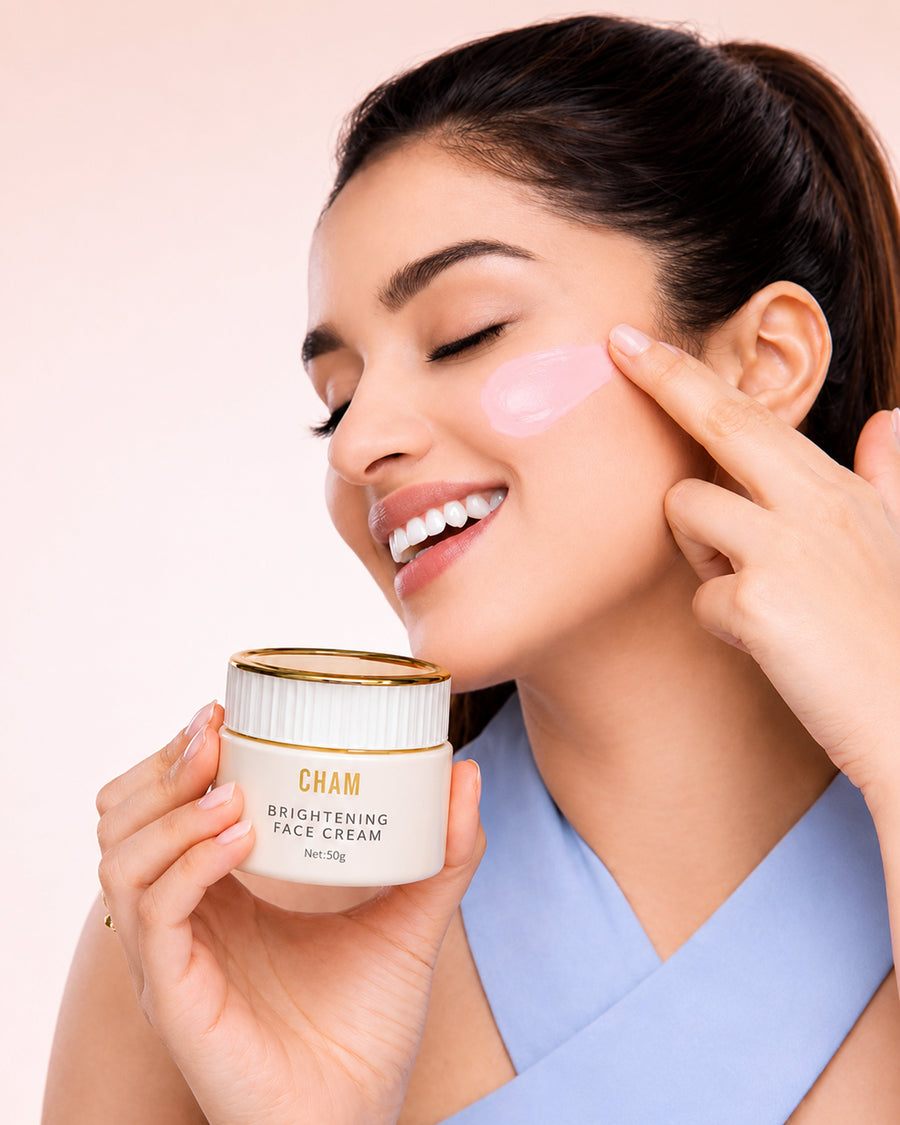
In the Cham range that product is the Brightening Face Mask, a weekly fifteen-to-twenty-minute step that carries alpha arbutin and niacinamide together with two stabilised forms of vitamin C, so production, delivery and the oxidative signalling upstream are each covered. The rest of the range, the wash, cream and serum, is built around niacinamide without arbutin, which is worth knowing when you read the labels.
Whichever route you take, the pairing itself is the easy part. The work is showing up for enough renewal cycles to let it matter.