The skincare aisle names its products like stages of a ceremony: toner, essence, serum, moisturizer, cream, each implying the next. It is worth saying plainly that these are formats, not obligations. Each one is a different way of getting ingredients onto skin, some overlap almost entirely, and most routines need fewer of them than the shelf suggests.
A serum is a delivery format
A serum is a light, fast-absorbing vehicle, usually water-based, carrying a comparatively concentrated dose of active ingredients. The thin texture is the point: it spreads easily, sinks in, and leaves little behind to interfere with the layers that follow. Its job is delivery. Which active it delivers (niacinamide, vitamin C, peptides, humectants) is the real identity of the product; "serum" only tells you the format.
Two honest caveats. Serum does not automatically mean strong: nothing stops a brand putting a trace of an active in a watery lotion and calling it a serum. And a serum is rarely enough on its own, because most are too light to slow water loss through the evening. It carries; it does not seal.
A moisturizer is a seal and a supply
A moisturizer is an emulsion of water and lipids. It does two jobs at once: it slows the evaporation of water from the outer layer of skin, and it supplies emollients and barrier lipids (ceramides, fatty acids, plant oils) that keep that layer flexible and intact. Many also carry humectants, so the better ones add water as well as keeping it.
"Cream" is not a separate category. Gel, lotion and cream are the same product family at different oil contents and thicknesses: gels are lightest, creams are richest, lotions sit between. So "serum vs cream" is not a contest to win. One delivers concentrated actives, the other keeps water in, and they are layered, not swapped. The blur is real, though: a cream can carry actives too, and a single formula can do both jobs at once. The names describe texture and intent, not a law of chemistry.
The toner question
A toner is an optional watery step, and its original job no longer really exists. Toners were invented to re-acidify skin after washing with alkaline soap. Modern cleansers are mostly pH-balanced, so the corrective task disappeared, and the category quietly reinvented itself as light hydrating waters and mild exfoliant vehicles. If a toner makes your skin feel good, there is no case against it. But nothing in a routine requires one, and skipping it costs nothing. Cham does not make a toner, so there is no pitch buried in that sentence.
The order is thinnest to thickest
Where layers are used together, the sequence is simple: watery formulas first, oily ones last. An oil-rich layer forms a film that water-based products cannot easily cross, so a serum applied over a cream is largely wasted. Serum, then moisturizer, is the whole rule for most evenings; in the morning, sunscreen goes last of all. The finer points, including how long to wait between layers (barely at all), are in when to apply face serum.
You do not need every layer
A complete routine, for most skin, is three products: a cleanser, one leave-on step carrying an active, and a moisturizer. The middle and final layers can even collapse into a single product, since plenty of moisturizers carry a working dose of an active. What the extra layers add, mostly, is cost and risk: every additional product is another set of ingredients to react to and another suspect to question when something goes wrong. A fuller argument for the short version is in a realistic night skincare routine.
The industry has an interest in the ceremony reading as mandatory. It is not. The stack is a menu, and two items from it, chosen well, are a meal.
When layering goes wrong
The usual failure is enthusiasm. Several actives applied at once make it impossible to know which one helped and which one stings. Products pill when too many films sit on top of each other. And irritation from an overloaded routine is regularly misread as a reason to add a soothing product rather than remove a step. If skin is stinging or flaking, the correction is nearly always fewer layers, not more. Skin that stays reactive no matter how simple the routine gets belongs in front of a clinician rather than a bigger shelf.
Where a serum fits against a cream is one of eight comparisons on the format finder, which also answers the question underneath in three taps: which format your skin needs, and whether you need two.
Where this sits in the Cham range
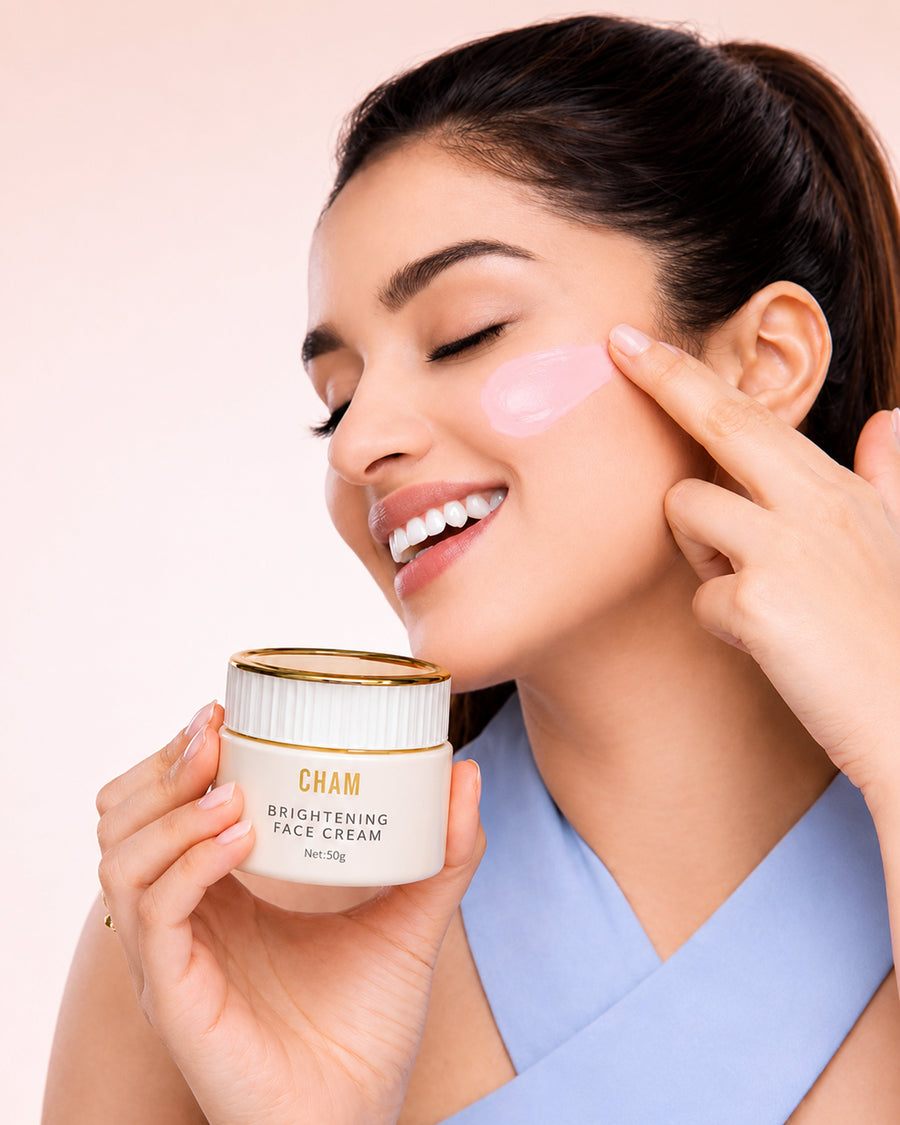
Cham's stack is deliberately short. The Brightening Face & Body Serum is the delivery layer: niacinamide with sodium hyaluronate, panthenol, allantoin and Ceramide NP in a light watery base, formulated for face and body rather than sold twice under two labels. The Brightening Face Cream is the seal above it, and shares much of the same ingredient logic. There is no Cham toner and no essence, which is not an oversight. Serum, then cream, thinnest to thickest, is the entire order of operations.