No. If lighten means what most people typing the question mean, a complexion fairer than the one your genetics gave you, then niacinamide does not lighten skin, and neither does any other cosmetic ingredient sold honestly. What niacinamide can do is narrower and more useful: it helps even the look of dark marks and patchy tone, so skin drifts back toward its own baseline rather than away from it. The rest of this post is that distinction, in detail, because the distinction is the answer.
Where the question comes from
Decades of fairness marketing trained a whole market to read every tone-related word as a promise of lighter skin. The products changed their labels; the search phrasing survived. So "does niacinamide lighten skin" is usually a sincere question about dark marks, wearing vocabulary inherited from an industry that deserved to lose it. The question deserves a straight answer in both halves: what the ingredient does, and what no ingredient does.
What niacinamide actually does to pigment
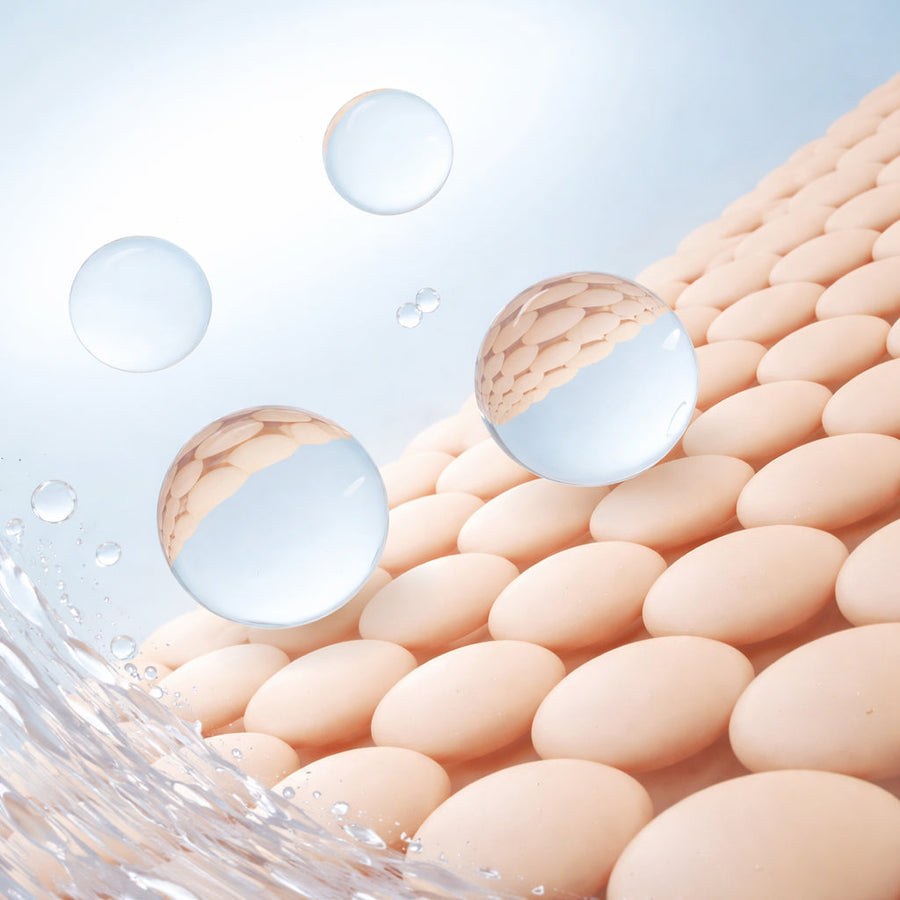
Melanin is made by specialised cells called melanocytes, using an enzyme called tyrosinase. The finished pigment is packed into small parcels and handed over to keratinocytes, the ordinary surface cells that display it. Colour, as you see it in the mirror, is mostly pigment that has completed that delivery.
Niacinamide works on the delivery step. It interferes with the transfer of pigment parcels from the cells that make them to the cells that show them. Pigment produced but not delivered does not appear at the surface. Niacinamide does not bleach pigment that already exists, does not switch melanocytes off, and does not touch the genetic settings that decide how much pigment your skin makes at rest. The full production line, and the other points where ingredients act on it, is walked through in how melanin production works.
Even, not lighter
Skin colour has two components worth separating. The first is baseline: the colour your skin is everywhere, set by genetics, stable across your life. The second is local excess: the extra pigment produced in one spot because of an old blemish, sun exposure, friction or past irritation. Those spots read as marks precisely because they sit above the baseline around them.
A transfer-slowing ingredient only changes what is visible where production is running above normal. As skin renews, marks made under calmer conditions drift toward the surrounding tone. The surrounding tone itself does not move, because it was never elevated to begin with. The honest outcome is skin that looks more even, in its own natural colour. That is what brightening properly means, and the word gets a full post of its own in what skin brightening means.
If a product promises more than that, promises fairness, whitening, or a lighter complexion, the promise is the problem. Cosmetics cannot deliver it, and the ones that historically tried relied on ingredients no one should put on their face without a prescription.
Niacinamide for hyperpigmentation, realistically
For the brown marks left after blemishes, and for tone that has gone patchy through sun and time, niacinamide is a reasonable choice: gentle, stable and easy to combine. It is worth knowing what "working" looks like. Skin renews on a cycle of roughly four weeks, and pigment sits in cells that have to be replaced before anything looks different, so one cycle is the floor rather than the expectation. Published trials on pigmentation generally run twelve weeks or longer for the same reason. Red or purple marks are a different problem entirely, blood rather than pigment, and a pigment-transfer ingredient does nothing for them; the difference is covered in acne marks versus acne scars.
Daylight is the other half of the job. Sun exposure is the signal that tells melanocytes to produce more, and slowing delivery while feeding production is working against yourself. Daily sunscreen does more for uneven tone than any brightening active manages without it.
When this isn't for you
- If the goal is a complexion lighter than your natural one, no cosmetic will get you there, and any product claiming otherwise has earned your distrust on principle.
- Melasma, pigmentation that is spreading, or darkening that arrived suddenly without an obvious cause belong with a dermatologist. These can have hormonal or medical drivers, and cosmetics are a supporting measure at best.
- On a compromised or irritated barrier, settle the skin before adding actives. Irritation itself drives pigmentation, so an active that annoys your skin can feed the exact problem it was bought for.
Where it sits in the Cham range
Niacinamide is the working core of the Brightening Face & Body Serum, one formula made for both face and body, since marks are not polite enough to stay on the face. The word on the label is brightening, and Cham means it in the only honest sense: evening the look of tone and marks, in your skin's own colour. Nothing in the range lightens skin, because nothing sold as skincare can.