Search results keep framing vitamin C and hyaluronic acid as a decision: which one, which first, which is better. The framing misreads both ingredients. They are not competing for the same job, and a routine can carry both without ceremony. The only genuinely useful question is the order they go on in, and that has a short answer.
Two different jobs
Vitamin C is an antioxidant with a side interest in pigment. It neutralises some of the reactive molecules that ultraviolet light and pollution generate in skin, and it slows the enzyme that produces new pigment, which together help the look of dullness and uneven tone.
Hyaluronic acid is a humectant: a large sugar-like molecule that binds many times its own weight in water. On an ingredient list it usually appears as sodium hyaluronate, the salt form, which is smaller and more stable. Applied to skin, it sits in the upper layers and holds water there, which smooths and plumps the look of the surface. The effect is real and it is temporary, maintained by reapplication, not accumulated.
One honest note about the name. The hyaluronic acid in a bottle is not topping up the hyaluronic acid your skin makes for itself in its deeper layers. Applied to the surface, it stays at the surface and does its work there, in the upper layers. That is a real job, done well, and it is a smaller one than some advertising implies.
One ingredient manages oxidation and tone. The other manages water content. Neither does the other's job even slightly, which is precisely why the pairing makes sense: a routine usually needs both jobs done.
The order, and why it works this way
The general rule is thinnest first, and both of these are thin, so the tiebreak comes from what each ingredient wants underneath it.
Pure ascorbic acid, the classic vitamin C, is formulated at a low pH and behaves best on clean, dry skin; damp skin carries it deeper than intended and stings. Hyaluronic acid wants the opposite: it works best applied to damp skin, with something heavier sealed over it, since a humectant holding water at the surface needs a lid to stop that water evaporating away.
So the sequence writes itself. Vitamin C first, on dry skin after cleansing. Then the hyaluronic step, on skin lightly damp again if convenient. Then a moisturizer over everything as the seal, and in the morning, sunscreen last. If your hyaluronic acid arrives inside the moisturizer rather than as a separate serum, the middle step and the seal merge, and the question mostly disappears.
The seal is not optional in dry air. An unsealed humectant in a parched room can end up trading water in the wrong direction, which is one reason "hydrating" serums sometimes leave skin feeling tighter. The distinction between adding water and keeping it is the whole subject of hydration versus moisturisation, and it is worth ten minutes if that sentence sounded backwards.
No conflict to manage
It is worth saying flatly, since the question drives many of these searches: there is no mechanism by which these two ingredients undermine each other. The chemistry is different and so is the job. They appear together inside single formulas constantly, which would be strange behaviour from rivals. Whether your vitamin C belongs in the morning or evening slot is a real question with a relaxed answer, covered in when to use vitamin C; wherever it lands, the hyaluronic step follows it, not the other way round.
Vitamin C is fussier with other company than it is with this. The pairing checker sets it against retinol and the exfoliating acids, where spacing them across the day beats layering them in one sitting.
When this isn't for you
- On a compromised or freshly irritated barrier, low-pH vitamin C is a poor guest, and even hyaluronic acid can sting when the surface is broken. Repair comes before layering anything.
- If skin feels tight and looks flaky, reaching for more actives is the wrong instinct. Water and a seal, applied boringly and daily, do more than a longer ingredient list.
- If a routine is already several actives deep, adding steps has a cost. Two well-chosen layers applied every day beat five applied when remembered.
Where these sit in the Cham range
Cham's answer to this pairing is spread across the week rather than stacked in one sitting. Sodium hyaluronate runs through the daily range: it is in the face cream, the face and body serum, and the body lotion, built into the everyday layers rather than sold as a separate step. Vitamin C appears only once, in the weekly Brightening Face Mask, as two stabilised forms alongside niacinamide and alpha arbutin. There is no daily Cham vitamin C serum, and no standalone hyaluronic serum either; that is a deliberate shape, not a gap waiting for a launch.
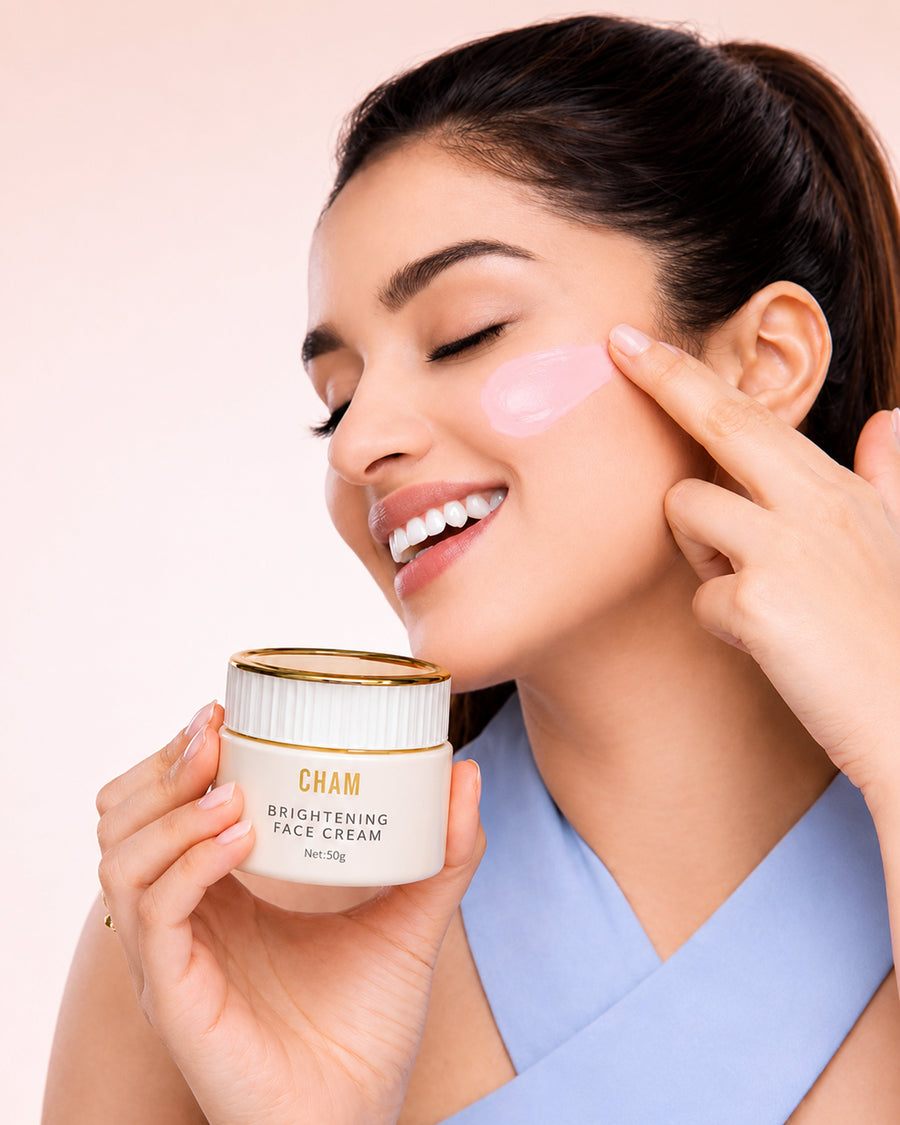
For the daily half, the Brightening Face Cream is the hydrate-and-seal logic of this post in a single product: sodium hyaluronate to hold water, ceramide NP and the cream base to keep it there, niacinamide for tone alongside. The full ingredient list is on the product page, which is where claims should always be checked.