Whether you can use body lotion on your face is really two questions: once, or every day. Once, in a hotel with a single bottle to hand, is fine. Nothing about facial skin makes body lotion dangerous on contact. The interesting question is what happens when the shortcut becomes the routine, and there the honest answer is that most body lotions are the wrong tool, for reasons built into how they are formulated.
Face skin and body skin are different surfaces
Facial skin is thinner than the skin on your arms and legs, and it carries far more sebaceous follicles per square centimetre, especially through the middle of the face. It is also the only skin that spends every day uncovered, dealing with sun, wind and pollution while staying visible enough that any reaction shows immediately.
Body skin is the opposite case: thicker, sparsely supplied with oil glands, and spending most of its life under fabric. Shins, elbows and heels run dry because almost nothing is oiling them. Skin like that wants generous, sealing formulas, and it tolerates them without complaint.
How body lotions are built
A body lotion is designed to cover a large, dry, tolerant surface quickly and pleasantly. That shapes the whole formula. It leans on richer occlusives such as shea butter and heavier emollients, because the target skin produces so little oil of its own. Very often it carries a higher fragrance load too, since scent is half the pleasure of a body product.
None of that is a flaw. On a shin it is exactly right. On a face it means more occlusion than most facial skin needs, sitting on a much denser field of oil glands, plus fragrance levels that thinner, more reactive skin is likelier to object to. The categories are separated by the skin they target, not by marketing whim. The wider taxonomy of lotions, creams and butters is unpacked in body lotion vs moisturizer vs body cream.
The label says which kind you are holding
Two quick checks reveal most of what matters. First, fragrance: the higher "parfum" or "fragrance" sits on an ingredient list, the more of it the formula carries, and body products routinely carry more than facial skin should be asked to enjoy. Second, the claim on the front. Firming, polishing, cooling and heavily scented body lotions are declaring extra ingredients, and every extra is one more thing for thinner skin to object to. A short, bland list is the only version of the category that comes close to face-friendly.
Occasionally versus routinely
Used once, on most skin: nothing happens. The emergency application is not worth a moment's worry.
Used daily, the odds shift. Congestion tends to show first along the jaw and hairline, where heavier textures linger longest. Skin that leans oily has the least headroom for added occlusion. Skin that reacts to fragrance may show low-grade sting or redness long before it shows a breakout, and repeated exposure is exactly how fragrance sensitivity develops: an ingredient tolerated for months can stop being tolerated, and the face is a poor place to run that experiment.
A side note for oily skin wondering whether every lipid-rich product is now off the menu: it is not. The ingredient and the texture are separate questions, taken apart in is ceramide good for oily skin.
The swap works better in the other direction
Face products on the body are fine. A facial formula is built for the more demanding surface, so nothing about it troubles an arm. The only objection is arithmetic: face products come in small containers, and covering a body from one is an expensive habit. This asymmetry is the whole story in miniature. The tolerant surface accepts anything; the demanding one does not.
A formula can serve both, if it was built for both
The useful distinction is that face-and-body is a formulation decision made at the start, not a permission granted afterwards. A product kept light, tested on facial skin, and restrained with fragrance can honestly serve both surfaces. A body product does not become one by being rubbed on a cheek.
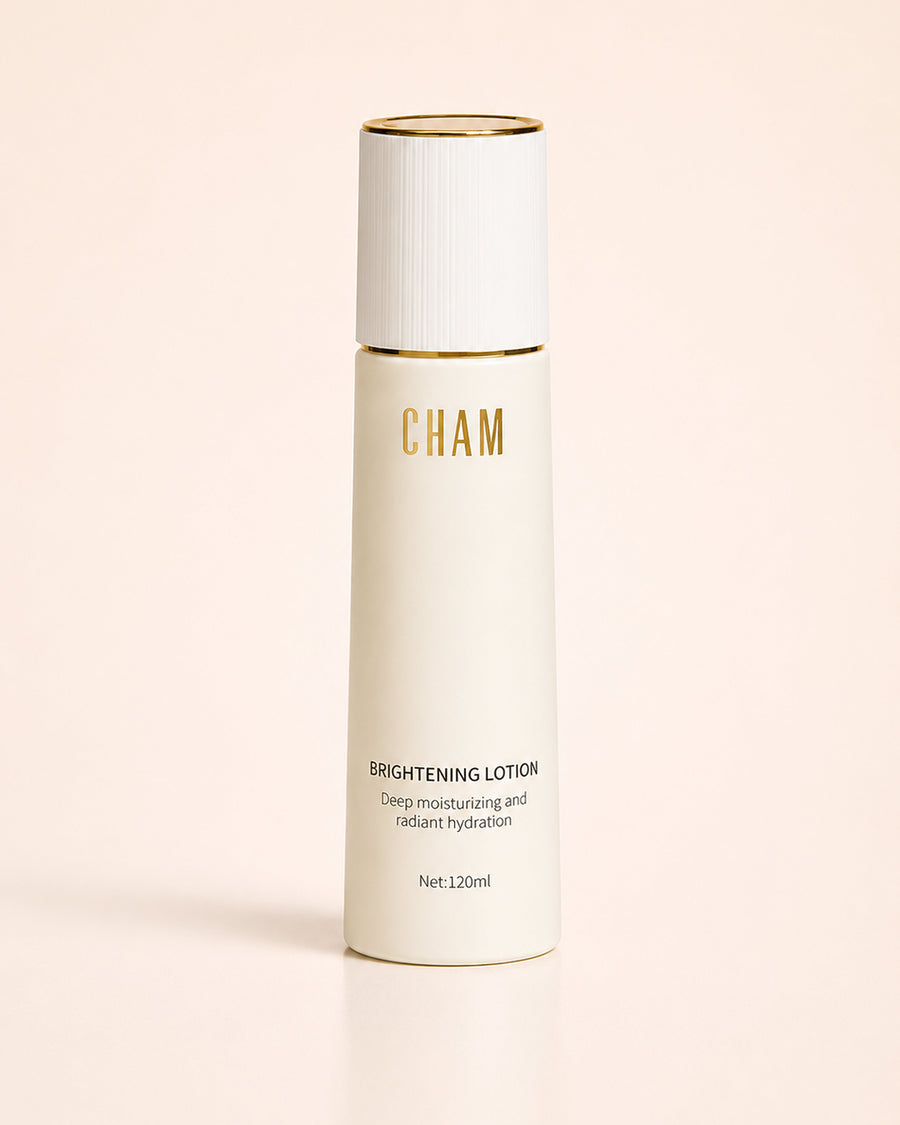
Cham's own range shows the contrast plainly. The Brightening Face & Body Serum is one formula, built around niacinamide, sodium hyaluronate and Ceramide NP, and formulated from the outset for face and body together. The Brightening Body Lotion, with its shea butter and richer emulsion, is a body product and stays one. The two sit side by side precisely because one is a genuine crossover and the other is not, and the labels say so.
The face-versus-body distinction is the one that actually holds on the format finder, which sets it beside cream against lotion and cleanser against face wash.
If you do use body lotion on your face
Pick the plainest one in reach: fragrance free if possible, no shimmer, no firming or exfoliating claims. Keep it away from the eye area, where skin is thinnest. Regard it as a stopgap rather than a discovery, and return to a facial product when you are home.
The one-night version of this question was never the problem. Skin forgives a single improvisation easily. What it keeps score of is the daily choice, and on that timescale the two surfaces deserve the two different products they were given.