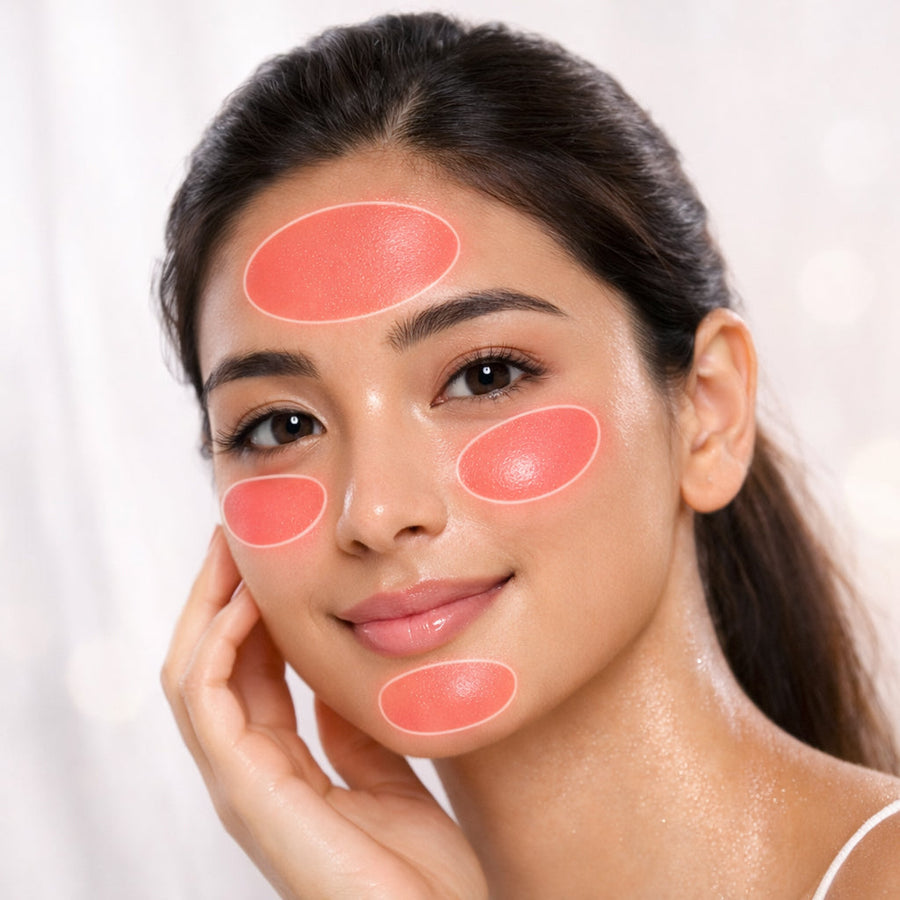
"Skin barrier" has become one of those phrases that appears everywhere and explains nothing. It is used to sell products, to diagnose problems over the internet, and occasionally to describe something real. This is an attempt at the third.
What the barrier actually is
The outermost layer of your skin — the stratum corneum — is often described with a brick-and-mortar analogy, and for once the analogy is genuinely useful.
The bricks are corneocytes: flattened, hardened cells that have migrated up from deeper layers, lost their nuclei, and become structural rather than living. The mortar is a lipid matrix filling the space between them, composed largely of ceramides, cholesterol and fatty acids.
That mortar does the work. It is what keeps water in, and it is what keeps irritants, allergens and microbes out. A wall of bricks with no mortar is not a wall.
This matters because most "barrier" products focus on the bricks — hydration, plumping, surface feel — when the interesting question is almost always the mortar.
What a struggling barrier feels like
There is no test you can run at home, and self-diagnosis over the internet is genuinely unreliable. But the cluster of signs is reasonably consistent:
- Products that were fine start stinging. This is the most telling one. A change in how your skin responds to something unchanged is more informative than any single symptom.
- Tightness that does not resolve after cleansing, even once moisturiser is on.
- Rough or flaky texture alongside oiliness — which confuses people, because it does not match the tidy dry-skin / oily-skin categories.
- Redness that lingers rather than settling within the hour.
- Dehydration that moisturiser does not fix. Water goes in and leaves again, because the thing that holds it is depleted. It is also the fastest route to skin that reads as dull.
If you recognise several of these at once, and they arrived after a change in routine, weather or environment, that pattern is worth taking seriously.
What actually damages it
Most barrier damage is self-inflicted, which is good news, because it makes it addressable.
Over-cleansing. Harsh surfactants strip lipids along with dirt and oil. Cleansing twice a day with something gentle is different from cleansing four times with something aggressive.
Too many actives, too fast. The common route is enthusiasm: an acid, a retinoid and a vitamin C introduced in the same fortnight because each was individually recommended. Each may be fine. Together and at once, they are a lot.
Physical exfoliation on already-irritated skin. Scrubs on a barrier that is already struggling extend the problem rather than clearing it.
Environment. Air conditioning, hard water, low humidity, sustained heat, long hot showers. In much of India, the swing between air-conditioned interiors and outdoor heat is itself a stressor, and it is easy to miss because it is constant.
Time and simple biology. Barrier function varies with age, hormones, stress and sleep. Not everything is a product problem.
What supporting recovery involves
The honest version is unglamorous.
Subtract before you add. The most effective single step is usually removing things, not introducing them. Pause the actives. Keep cleansing, moisturising and daytime sun protection. Give it time before concluding anything.
Replace what is missing. Since the mortar is largely ceramides, cholesterol and fatty acids, formulations containing those lipids are working with the biology rather than sitting on top of it. Cham's Brightening Face Cream is formulated with niacinamide, Ceramide NP and Rosa Damascena flower water — a ceramide-containing base rather than an occlusive alone.
Cleanse gently and less often. A cleanser that leaves skin feeling squeaky has taken more than it needed to. Cham's Brightening Face Wash is built around niacinamide and Rosa Damascena flower water for this reason — the point of a cleanser is to remove the day, not the lipid matrix.
Protect during daylight. UV exposure is a barrier stressor as well as a pigmentation one. Sun protection is not a separate concern from barrier recovery.
Then wait. Skin cell turnover is not fast, and lipid replacement is slower still. Recovery is measured in weeks, not applications. Anyone promising otherwise is selling something.
Reintroducing actives afterwards
Once things have settled, the temptation is to resume everything at once. That is usually how the cycle restarts.
One product at a time. Space the introductions out. Give each one long enough that if something goes wrong you know which thing caused it. Reintroduction is slower than the original enthusiasm, and it is the part that determines whether you end up back here.
When this is not for you
- If your skin is painful, weeping, blistering, or spreading, that is not a barrier conversation. See a doctor. Those signs point somewhere else.
- If you have a diagnosed condition — eczema, psoriasis, rosacea, seborrhoeic dermatitis — barrier support may be part of managing it, but it belongs inside a plan from your dermatologist rather than instead of one.
- If symptoms persist despite simplifying for a sustained stretch, stop troubleshooting it yourself. Persistent symptoms that do not respond to a stripped-back routine are worth a professional opinion.
- If you are dealing with a reaction to a specific product, stop that product and note what was in it. That information is more useful than any general routine.
Cosmetic products support skin. They are not medicine, and nothing here diagnoses anything. When in doubt, the dermatologist is the shortcut, not the last resort.