Free skin analysis

Free skin analysis online, from a selfie that stays on your phone

This page reads redness, tone evenness and T-zone shine from your photo, inside your browser. It uploads nothing and needs no account. This is a cosmetic reading, and it can't diagnose anything.

One selfie, three readings

What the scan reads

Each reading compares your face with itself, so there is no score out of a hundred and no ranking against other people. All the possible results are written out below. Three questions then cover what a photo can't show and narrow the page to one routine.

Redness

How far the reddest parts of your cheeks, nose and chin sit above the colour of the rest of your face. Because it compares your face with itself, a warm-looking photo moves it less than you'd expect. Redness is harder to see on deeper skin, for a camera and for a person, so a low reading there doesn't rule it out.

Little
Nothing stands out as redder than the rest of your face in this photo.
Some
Some areas read redder than the rest. Recent washing, heat, sun, a spot or a product that didn't suit you can all do this, and a photo can't tell them apart. See whether it fades through the day.
Clear
Parts of your face read clearly redder than the rest. If it lasts for weeks, burns or keeps coming back, see a dermatologist before adding products. Until then, keep the routine simple. Read about sensitive skin.

Tone evenness

How much your skin's lightness varies from patch to patch inside each area of the face, which is where marks and blotches show up. It says nothing about how light or dark your skin is, and the scan doesn't score that at all, because no skin tone is a better result than another.

Even
Your tone reads even from patch to patch in this photo.
Some variation
Some patches differ from the skin around them. Marks left by old spots and sun exposure are common reasons. The fade timeline shows how long a mark usually takes to fade.
Patchy
Some patches stand out clearly from the skin around them. For a mark left by a spot, use the fade timeline. Matching patches across both cheeks could be melasma, which is worth showing a dermatologist, and the melasma planner covers the seasons around it.

T-zone shine

How much of your forehead, nose and chin shows bright highlights compared with the skin around them. A lamp or a flash adds shine of its own, so daylight gives a truer reading. This is about oil on the surface when the photo was taken, and it says nothing about how much water your skin holds.

Little
Your T-zone shows hardly any highlights in this photo. If you washed your face just before taking it, try again a few hours later, once oil has had time to come back.
Some
Some shine shows, mostly where you'd expect it. On its own this doesn't need fixing.
Strong
Strong shine shows through your T-zone. Washing harder won't lower oil output, because hormones set it. Shiny and tight at the same time is common, and oily but dehydrated skin explains why.

The routines

All nine routines are written out below. If you'd rather not take a photo, the questions above still work without one.

New products often sting

Settle your skin before adding anything

If new products often sting or leave you red, a new active is the wrong next step, and it will get the blame for the wash that came before it. Put strong foaming washes, alcohol-heavy toners, daily clay and scrubs away first.

In practice Use a mild wash and one moisturiser, and nothing else, until the stinging stops. Then add one product at a time so you can tell what caused a reaction. If your skin stays reactive on a routine this simple, see a dermatologist.

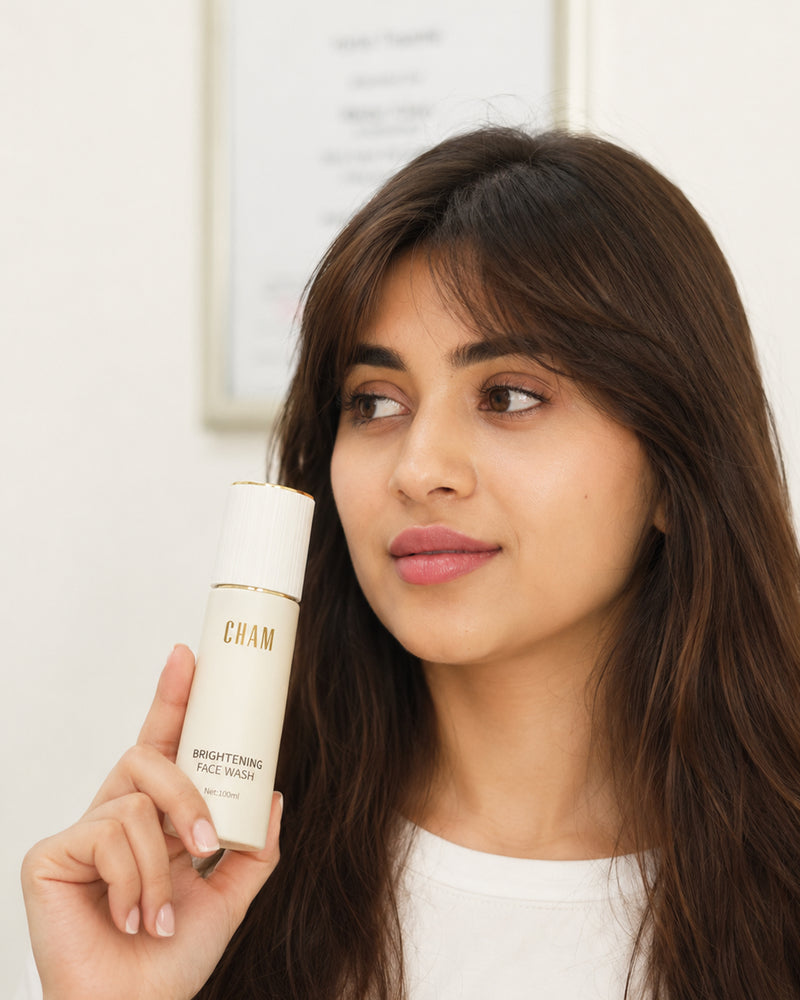
The Brightening Face Wash is low-foam, with no exfoliating acids. The Brightening Face Cream carries glycerin and sodium hyaluronate for water, with Ceramide NP and wheat germ oil for lipids. Patch test either one first, since your skin is telling you it's reactive.

Marks or uneven tone, tight skin

A serum under a cream

A serum carries the active, and it's too light to slow water loss on its own. Skin that feels tight needs the cream on top to seal things in, or the serum stings and gets blamed.

In practice Thinnest to thickest: serum on damp skin, then cream. In the morning, sunscreen goes on last. Cham doesn't make one, so that step comes from elsewhere.

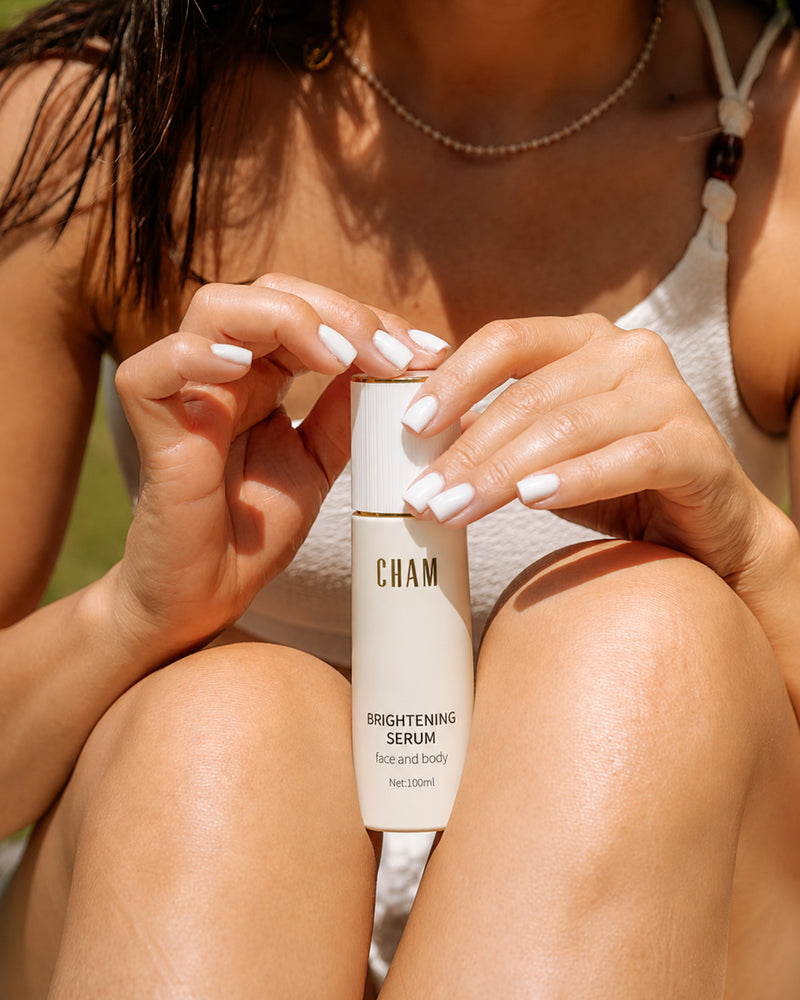
The Brightening Face & Body Serum is built around niacinamide, with sodium hyaluronate, panthenol, allantoin and Ceramide NP. The Brightening Face Cream is the seal above it.

Marks or uneven tone, oily skin

A serum on damp skin, with cream only on tight nights

Oily skin can carry an active in a watery serum without the oil phase of a rich cream. What it usually doesn't need is more degreasing, because the glands are set by hormones and a stronger wash won't change them.

In practice Gentle wash, serum while the skin is still damp, then decide. On comfortable nights, stop there. On tight ones, add a thin layer of cream. In the morning, sunscreen goes on last, and Cham doesn't make one.

The Brightening Face & Body Serum carries niacinamide, glycerin and Ceramide NP in a light watery base. The Brightening Face Cream is the heavier step, so let your skin decide how often it wants it.

Marks or uneven tone, tight then oily

A milder wash first, then serum and a light cream

Tight after washing and shiny later usually points to a wash that is too strong. Fix that before judging any active, since a serum on stripped skin stings and takes the blame.

In practice Switch to a mild, low-foam wash. Then use the serum on damp skin and a light moisturiser over it so the water stays. Expect the tightness to ease before anything else changes. In the morning, sunscreen goes on last, and Cham doesn't make one.

The Brightening Face Wash is low-foam for this reason. The Brightening Face & Body Serum carries the niacinamide, and the Brightening Face Cream goes over it.

Marks or uneven tone, comfortable skin

A serum, with a moisturiser over it

Your skin isn't asking for a repair, so the only addition is the active you want, in the lightest format that carries it. Every extra layer is another thing to react to.

In practice Thinnest to thickest: serum, then moisturiser, and sunscreen last in the morning. Cham doesn't make a sunscreen. A sheet mask once or twice a week is optional.

The Brightening Face & Body Serum is the delivery layer and the Brightening Face Cream is the seal above it. The Brightening Face Mask is the concentrated weekly dose in the same direction.

Comfort, tight skin

A cream, and in a dry month, two steps

Tightness hours after washing, flaking, or a dull look in a dry month are signs that your skin wants the richer end. Flaking in particular is a lipid shortage, and water alone won't fix it.

In practice One well-built cream carrying humectants and lipids does both jobs for most skin. When it isn't coping, add a humectant layer underneath, and evenings are the better slot for that. You have it right when nothing feels tight after washing and nothing flakes.

The Brightening Face Cream is the single-product version, with glycerin and sodium hyaluronate for water and Ceramide NP and wheat germ oil for lipids. The serum goes underneath it in the two-step version.

Comfort, oily skin

A gentle wash and a watery layer

Oil and water are separate things, so skin that shines by afternoon can still run short of water. It usually doesn't need the oil phase of a rich cream.

In practice Twice a day is enough for washing. A few minutes after rinsing, your face should feel like skin, and squeaky means stripped. Follow with a watery serum while it's still damp. If your skin stays comfortable and isn't tight after washing, a moisturiser is optional.

The Brightening Face Wash sits at the mild end on purpose. The Brightening Face & Body Serum is the light watery layer. Cham makes no clay mask, scrub or mattifier.

Comfort, tight then oily

Water first, then a light seal

Tight after washing and shiny a few hours later isn't a contradiction. Your glands keep producing at their set rate while a stripping wash drains the water, which is uncomfortable and usually self-inflicted, so you can stop it.

In practice Subtract first: swap the strong degreaser for a mild, low-foam wash, and put alcohol-heavy toners, daily clay and scrubs away. Then add water back with a light humectant layer and a light moisturiser over it. The tightness should ease before the shine changes, if the shine changes at all.

The Brightening Face Cream suits this: a light daily texture with glycerin and sodium hyaluronate for water and Ceramide NP and wheat germ oil for lipids. The wash in the range is low-foam for the same reason.

Comfort, comfortable skin

Keep what you're doing, and one light cream is enough

Comfortable skin doesn't need much. A wash that leaves it comfortable has done its job, and there's no case for changing it because of a word on a label or a reading on this page.

In practice Match the texture to the season rather than the price. Skin that's comfortable in a humid month may want one rung richer in a dry one, and that's the whole adjustment.

If you're shopping for one, the Brightening Face Cream sits at the lighter end of cream for daily wear. Cham makes no toner or essence, and skipping a toner costs nothing.

This page reads a photo. It doesn't diagnose. A mole that changes, or anything that bleeds, hurts or won't settle, belongs with a dermatologist rather than a scan.

Before you trust a number

How to get a reading you can use

Light matters more than the phone. Face a window in daylight, without direct sun. Light from one side makes half your face look different from the other, and a lamp or flash adds shine that isn't yours. The scan refuses photos it can't read properly and tells you why.

Wait after washing. Oil takes time to come back and washing can leave you flushed, so a photo taken straight after a wash reads differently. The bare-face test asks for three to four hours with nothing on, and the same wait suits a scan.

Makeup, beards and filters change the result. Foundation hides what the scan is looking for. A beard covers part of the cheeks and chin, so the readings come from less skin. Beauty filters smooth out the patches and redness it measures. Turn them off.

Compare like with like. Two selfies in different rooms can differ for reasons that have nothing to do with your skin. If you want to track a change, use the same window at the same time of day. A single scan tells you much less than that.

What it can't do

What a selfie can't tell you

A photo shows the surface in one moment. It can't feel tightness, so it can't tell dry skin from oily skin that has been stripped, which is why the questions ask. It can't tell why an area is red or dark. It can't judge a mole or a lesion, and you shouldn't use it to try.

We left out a few things other scanners report. There's no skin age and no score out of a hundred, because a phone photo can't support that kind of precision. And there's no reading of how light or dark your skin is. Cham sells brightening products, and a scan that called a complexion a problem to be solved would be the wrong tool for anyone to trust.

If you already know the question, these go further than a scan: the format finder for what to buy, the pairing checker for what to combine, and the tan fade calculator for a recent tan.

The questions behind the searches

Asked constantly

Is this skin analysis really free?

Yes. There's no charge, no account, and no phone number or email to give. Cham sells skincare, and the routines link to Cham products where the range has something that fits, and say so where it doesn't.

Is my photo uploaded anywhere?

No. Your browser reads the photo on your device, and it's gone when you scan again or leave the page. Cham never receives it, or the readings taken from it. The scanner's own files download from jsDelivr and Google's servers the first time you use it, about 7 MB in all, and those servers see an ordinary download request with no photo in it.

Is this AI skin analysis? Can AI analyse skin?

Partly. MediaPipe, a machine-learning model from Google, finds your face and places 478 points on it. The three readings are then colour measurements from the areas those points mark out. No chatbot sees your photo. AI can measure what a camera captures, but it can't examine your skin the way a dermatologist can, so take any online scan, this one included, as a starting point.

How accurate is an online skin analysis?

It depends heavily on the light. These readings are measurements of a photo, and the same face can read differently in a different room. We don't claim dermatologist-level accuracy, and be wary of any free tool that does without showing how that was tested. Take the broad result as a prompt to look closer.

Does it work on Indian skin tones?

The readings compare your face with itself, so how deep your skin tone is doesn't set the result. One limit does apply: redness is harder to see on deeper skin, for cameras and for people, so a low redness reading there doesn't rule it out. The page doesn't score your skin tone at all.

Can a selfie show your skin type?

Not on its own. Shine in a photo hints at oil, but skin type also depends on how your skin feels, and a camera can't feel tightness. The questions on this page cover that part. To settle it properly, the bare-face test takes a few hours and costs nothing.

Can this replace a dermatologist?

No. It can't diagnose anything, and it doesn't look at moles or lesions. See a dermatologist for anything new that changes, bleeds, hurts or won't settle, and for dark patches that keep coming back.